Blood clot in leg vein can be deadly
excerpt taken from Contra Costa Times
Q: Nine months ago, our son, 42, had a deep-vein thrombosis. The clot was in the calf and thigh vein. He was given an anticoagulant and the clot was surgically removed, but surgery was only partly successful. Some of the clot remains in his leg veins. He continues to take Coumadin and is told it may take a year for the clot to dissolve. His calf is often swollen and painful. Can you suggest any additional treatment?
A: For readers unfamiliar with this problem, some definitions are necessary. Thrombophlebitis (THROM-boh-flea-BITE-is) is a clot in a vein. "Thrombo" means "clot," and "phlebitis" is vein inflammation. The leg is the common site for it to happen. A person on bed rest after surgery (especially knee and hip surgery), who is sitting for prolonged times during a car or plane trip, taking birth-control pills or suffering trauma is at risk of getting thrombophlebitis.
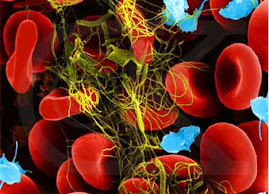
Clots in the deep veins of the leg, the ones you cannot see, are the dangerous kind. Bits of those clots can break away from the main clot and be carried in the circulation to the lung, where they can plug a lung blood vessel. That's called a pulmonary embolism, and it can be deadly.
Clots in leg veins cause the overlying skin to turn red and become tender. The leg swells and is painful. Ultrasound examination of the veins establishes the diagnosis.
Anticoagulants are the treatment. They don't dissolve the clot, but they keep it from growing larger and they prevent the chance of a pulmonary embolus. In time, a canal burrows through the clot, and blood flow is re-established or blood finds alternate routes to leave the leg. It takes months for this to occur. Nothing speeds the process. Time is the medicine of choice.
A large number of people develop what's called the post-thrombotic syndrome after thrombophlebitis. The leg remains swollen and painful. Compression stockings and frequent leg elevation minimize this complication.
Tuesday, February 19, 2008
Good Information On DVT - Only Taking Coumudin for 1 year


Tuesday, February 5, 2008
Coumadin - Forgetting to take coumadin
I have noticed that whenever I forget to take coumadin that I get phantom pains in my leg that the blood clot happened in. Sometimes I get headaches also. I wonder if this has to do with my blood getting thicker???
I have enquired with my doctor about the consequences if I stop taking it and she has told me that it stays in your system for at least three days even though your blood level will gradually get thicker over that time. She smiled and told me that I would feel it if I stopped taking it...
Another nurse told me that one of her patients stopped taking coumadin and kept ending up in the intensive care unit with a heparin bag next to his bed.
These could all be scare tactics to make the drug company who makes coumadin, Bristol-Myers Squibb Company, lots of money. I am very weary of how much influence drug companies have and am always weary of the gift bags I see the drug representatives bring into my doctors office but a little rat poison has never killed anyone right?
My father who had suffered a blood clot that almost killed him, had a doctor that was vehement about him not staying on Bristol-Myers Squibb Companys wonder drug.
All I know is that I can definitely feel some type of twinges of pain in the leg that had the blood clot when I forget to take my coumadin. It usually takes 4 hours but I do feel it.
Saturday, January 19, 2008
What I Believe Caused My DVT
I have been told its a vitamin K deficiency is the cause of my blood clots but I believe it was caused from falling through my newly renovated floor. I have went to two specialist and one primary doctor who have all told me different things. I should do more research on my own. I do not want to take rat poison (warafin) for the rest of my life.
I found this article and though it was relevant:
Minor Leg Injuries Might Boost Blood Clot Risk
Thu Jan 17, 5:02 PM ET
THURSDAY, Jan. 17 (HealthDay News) -- Minor leg injures -- including ankle sprains and muscle ruptures -- could raise the risk of blood clots in the legs or lungs, suggests a study by researchers in the Netherlands.
Previous research found that major injuries and related treatments such as surgery, a plaster cast, and extended bed rest increase the risk of venous thrombosis, which includes blood clots in the leg as well as more dangerous blood clots that have traveled to the lungs (pulmonary embolism). But the risk associated with minor leg injuries was unknown.
In this study, the researchers at Leiden University Medical Center studied almost 2,500 people who developed venous thrombosis between 1999 and 2004. They compared those patients with a control group of more than 3,500 people without venous thrombosis.
They found that 289 (11.7 percent) of the patients had sustained a minor injury in the three months prior to developing venous thrombosis, while just 154 (4.4 percent) of those in the control group had a minor injury in the three months before the study.
"Minor injuries that do not require surgery, a plaster cast or extended bed rest were associated with a threefold greater relative risk of venous thrombosis," the study authors wrote.
"The association appeared local, because injuries in the leg were associated strongly with thrombosis, while injuries in other locations were not associated with thrombosis. The association was strongest for injuries that occurred in the month before the venous thrombosis, suggesting a transient effect."
The researchers also found the association was stronger in people with genetic or other risk factors for blood clots.
The study was published in the Jan. 14 issue of the journal Archives of Internal Medicine.
More information
The Society of Interventional Radiology has more about deep vein thrombosis.
Monday, December 24, 2007
Swelling After Surgery

Well it was interesting after getting out of the hospital how much swelling I encountered in my leg. The doctor told me to expect this but I have to say it was a little shocking. It looked more like pooling of blood in my leg than swelling. My leg was very dry (or ashy) and the overall shape of my lower leg became distorted.
The good news is that as time went on this swelling got less noticeable (a couple of years later). Even though it became less noticeable every now and then I it seems to swell more than at other times. The doctor told me that this could be my body passing clots throughout my system. I think it is more timed around me forget to take my coumadin.
I want to get off this stuff because taking a pill every day at 36 is no fun.
What I thought Was A leg cramp was a blood clot (or Deep Vein Thrombosis)
I remember how it felt, a tightness in my upper thigh. I thought I had pulled my groin muscle or something. The worst thing that I did was wait. No one tells you what these things feel like. And when they do they use complex descriptions.
I will tell you that the blood clot I had felt like I had a pulled muscle.
I was walking around it for days. I even had my friend massage this "pulled muscle." When I think about it, it kind of makes me cringe. My friend sitting there rubbing this deadly blood clot in my leg, yuck. If it was massage the right way I a sure and the doctors where sure that it would have killed me.
This tightness was the blood being restricted in my veins by the clot.
If you feel this tightness in your extremities (arms or legs) go to a hospital immediately.
I made the mistake of going to an urgent care facility. They misdiagnosed it completely ...